



Now that I have used and own a farmhouse sink…I can’t imagine buying any other type ever again.
Evolution of the Farmhouse Sink
Back in the day when homes didn’t have plumbing systems, people had to haul water from lakes, rivers, and wells for washing dishes, boiling food, and cleaning their clothes. Dishpans and dry sinks, which had to be filled and drained manually, were the only options available.
Then the farmhouse sink was born. Also known as apron sinks, (or apron front sinks) these large kitchen basins were often found in rural homes of decades past. They were originally designed for comfort, since women spent long hours at the sink (and still do).
In the late 17th Century in Britain, two very popular butler sinks (apron sinks originally made for the butler’s pantry) began to find their way into homes of the wealthy: the Belfast and the London. Each of these sinks is appropriately named after the cities where they originated.
The Belfast apron front sink had a larger basin and was fitted with an overflow, which allowed the water to drain rather than spill over the edge of the sink if it overfilled. Belfast, Ireland had access to plentiful water sources and they weren’t concerned with over-usage. London, England, on the other hand, was built on clay; they had to dig very deep to find clean water sources and had serious issues with water usage. To conserve water, the London apron front sink was smaller in depth and had no overflow.
The French Farmhouse Sink
Toward the end of the 19th Century, the French Farmhouse sink, with a broad apron front, began to gain popularity for its strength and utilitarian value. These were often more refined, and made of white clay from Limoges, France. This iconic sink is still often used in French-inspired country kitchens – with draped classic linen hiding the base of the cabinet.
The trend continued in the United States during the 1920s, when sinks of cast iron became all the rage. A copper and nickel alloy kitchen sink was used to make a corrosion-resistant and lightweight kitchen sink. But soon copper and nickel became less available during WWII because those resources were needed to fight the war. And so, with the modernization of American kitchens, the traditional farmhouse sink stepped aside to the standard and more affordable undermount stainless steel sink.
Undermount and Drop In Sinks
A drop-in sink has a rim or lip that rests, and can easily be lowered into a designated space in the counter-top. The rim of the sink extends so that it rests on the counter and carries the weight of the sink.
Undermount sinks are installed under the counter, rather than being dropped into a hole. Because of the way they are installed, there is no rim between the countertop and sink.
Bacteria and gunk can build up with both types of sinks. As with drop in sinks, bacteria and gunk can build up in the gap on the top of the sink where it joins the countertop. Undermount sinks, although less visible also have a gap at the top of the sink where it joins up to the counter where bacteria can collect.
The Modern Farmhouse Sink
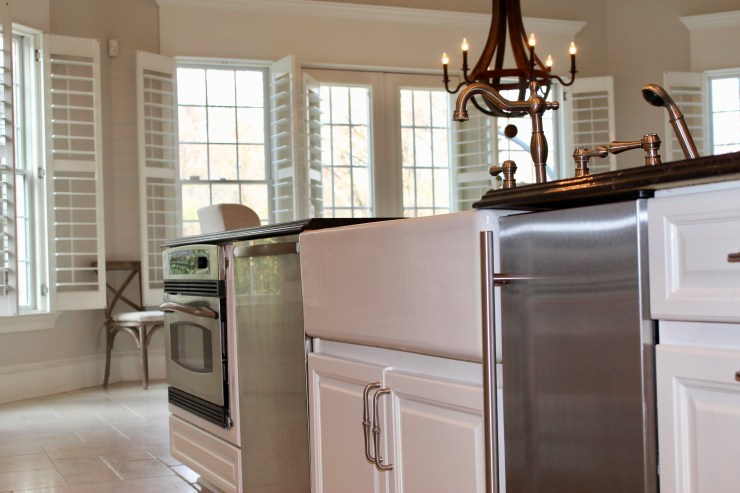
In this new millennium, we are looking for function and style. The intrinsic design of the apron front farmhouse sink offers benefits that one wouldn’t find in a common kitchen sink. The exposed front allows for more internal basin space, accommodating large pots, pans, and baking sheets. Surrounding kitchen cabinets are more protected because the apron front often extends past the cabinetry and any pooling water will drain to the floor instead of onto cabinets.

The Best Sink I have Ever Owned
While the undermount stainless steel sink is the clear winner over a drop in sink, it still pales in comparison to the farmhouse sink. I have owned many styles of sinks over the years and I have to say that my all time favorite is the farmhouse sink…hands down! This sinks’ spaciousness, design, comfort, and quality makes it the clear choice in kitchen sinks.


Another tip, if you love the farmhouse style, check out this unique dream sink HERE, and faucet HERE no doubt you have seen it many times on Fixer Upper. I LOVE this sink, it can be used in a kids bathroom, utility room, pool house, powder room…the possibilities are endless! This sink is definitely on my wishlist.
What’s on your wishlist?
For more home decor inspiration and tips, subscribe to Happy Haute Home and follow along on Pintrest HERE, and Twitter HERE and feel free to pin and tweet your favorite pics from Happy Haute Home.
You can also get daily home decor inspiration by following along on Instagram HERE.


