



Outdoor flooring options on the market today are endless, and the number of choices overwhelming. After narrowing down the choice to Travertine for our patio project, we decided to use pavers instead of tiles. Why? Let’s discuss.
Travertine Tiles vs. Travertine Pavers
So what exactly are the major differences between tiles and pavers? One of the biggest differences between Travertine tile and Travertine pavers is the thickness of the material. Tiles are typically 1/2″ thick, while pavers are much thicker, ranging from 1 1/4 – 2″ in thickness. Travertine tiles are typically used indoors and have very square edges. On the other hand, pavers can have a chiseled or tumbled edge and can be installed outdoors using sand and gravel versus the typical grout application of tiles.
Laying Tiles and Pavers Using the “French” or “Versailles” Pattern


Natural stones, such as Marble and Travertine, commonly come in dimensions of 8″ x 8″, 8″ x 16″, 16″ x 16″, and 16″ x 24″. The above picture depicts the “Versailles” or “French” pattern using the 4 different sized tiles.


Marble Pavers Were Also an Option
We considered using Marble for our patio but ultimately decided against it. We knew Travertine was the right stone for the project. One reason that I was considering Marble, were the color choices. With the color tones of our house (and future color tones :)), I knew I wanted something other than brown. Most of the Travertine stones I looked at had brown tones while the Marble ones had white tones. I wanted a whiter paver but in Travertine not Marble.
In Five Changes to Completely Transform any Room – Our Basement Renovation and Remodel Ideas, we chose to use Marble tiles on our flooring.

In our prior home, we removed carpet and installed Marble stones to finish our basement floors. Marble is absolutely beautiful.


The space is 1600 square feet and we used brushed/chiseled tiles, 1/2″ thickness.
Finding the Right Travertine Pavers for Our Patio Project
While finding the right color was a bit tricky, I eventually found what I was looking for, in both color and size.
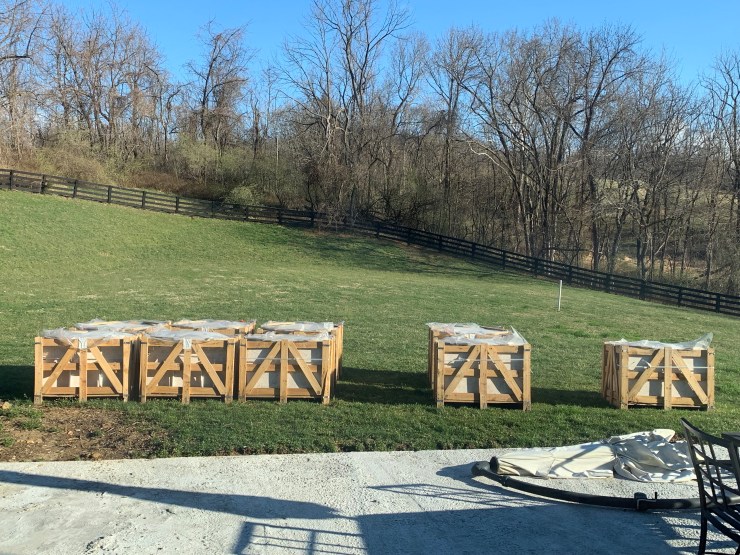


Outdoor Travertine Paver Installation – Dry Set vs. Mud-Set
Lastly, Travertine can either be dry-set (laid in a bed of sand) or mud-set (set in mortar on top of a concrete slab). We chose to mud-set our pavers on a concrete slab, but it is more common to lay them in a bed of sand. The advantage to dry-set installation is that it allows you to replace a paver easily if it becomes damaged, and it’s a lot less expensive. The process is a bit trickier if the stones are mud-set, but we feel the pavers are more secure and there will be less movement being set on concrete but this option is more costly.
Check out Other Outdoor Project Posts
For more about our outdoor patio project, check out
Hardscape Design – Laying a Concrete Foundation for the Backyard Patio (Part 3)
Hardscape Design – Outdoor Fireplace Demolition (Part 2)
Hardscape Design – Patio Demolition (Part 1)
Please Subscribe to Happy Haute Home
For more outdoor improvement projects, please subscribe to Happy Haute Home and follow along on Pinterest HERE, and Twitter HERE and feel free to pin and tweet your favorite pics from Happy Haute Home!
You can also get daily home decor inspiration by following along on Instagram HERE. If you use any of my tips and suggestions, tag me on Instagram, I would love to see it!
